
By Ms. Akhtar, Grade 4 Homeroom teacher and EAL teacher.
Most of us think that photography is a modern invention. However, it began with the camera obscura way back in the 10th Century AD but there is also some evidence to suggest that the great Greek philosopher Aristotle (who was a student of Plato and himself a teacher of Alexander the Great) knew about the technique in the 4th Century BC during the height of the Golden Age of Greek Civilisation. The Greeks didn’t investigate the camera obscura. The camera obscura was a dark room with a tiny hole in one wall and a white screen on the opposite wall.
Fast forward 1400 years to the 10th Century when a young Iraqi man travels to Egypt with the grand plan of finding a solution for the flooding of the River Nile which was resulting in loss of life and property. Realising the enormity of the task and that it was beyond his capabilities (Egypt got a dam 900 years later with the help of modern technology), he feigned madness in order to avoid severe punishment and ended up under house arrest.
During his 10 year confinement, the young man known as Al Haytham, carried out many scientific experiments in the area of Optics and the camera obscura. Using a pinhole, he discovered that images and scenes from outside the camera obscura were turned upside down and projected onto the wall after passing through the pinhole. His investigations led to the understanding of light and how the eye works in the same way as the camera obscura. He discovered that light travels in straight lines from its source, hits an object and is reflected into our eyes, an upside down image is formed at the back of our brain and then our brain then flips it the right way round.
500 years later in the 16th Century, lenses were added to the hole of the camera obscura to produce a more sharper and brighter image. Over time, the camera obscura became more compact and the image was projected onto thin paper on glass so that it could be traced by artists.
Then in 1725 Johann Schultz learned that by exposing some silver salts to light could capture the image without tracing and over the next 75 years, scientists carried out more investigations on the silver salts but no one could practically use the discovery to produce permanent images. The first permanent photographs were produced around1826 and in 1839 came the first commercially manufactured camera. Lastly, by 1975 we progressed to digital photographs. This is one innovation that has changed the world and brought so much ease into our lives. Now according to Samsung, around 2.5 billion people all over the world have a digital camera.
There is no doubt that the ancient Greeks were ahead of their time but could we really have had the camera earlier if they had persevered and not given up and if so, how different would our world look now?
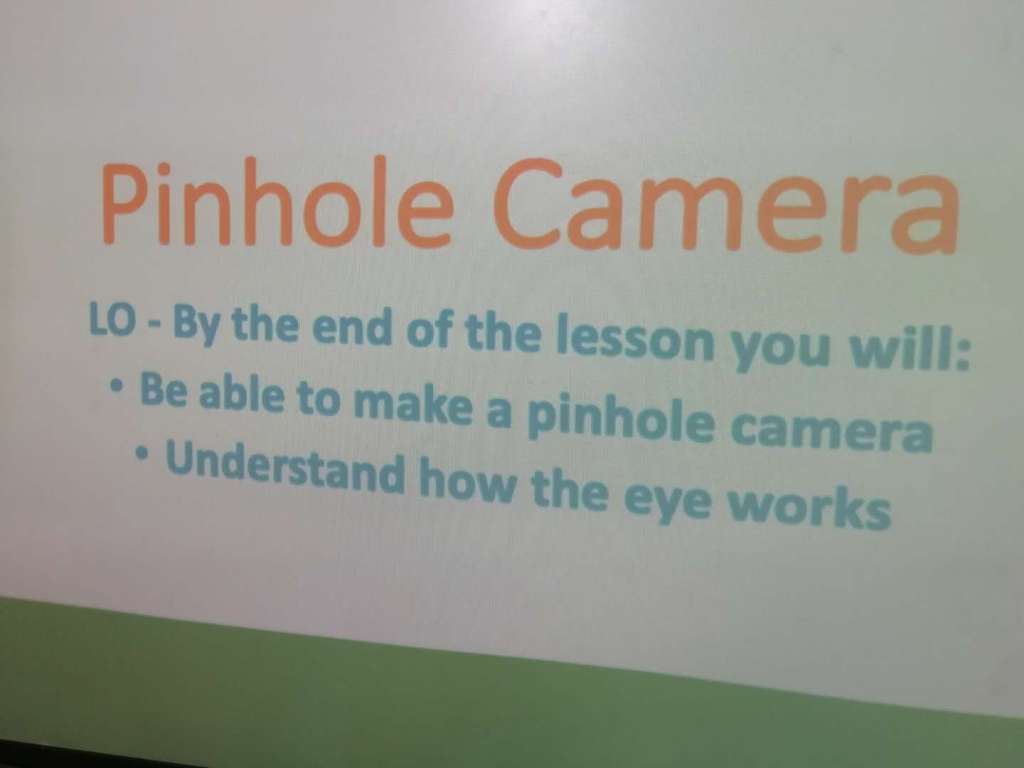
Pictures show Grade 4 students at CISS currently studying the ancient Greeks, make their own pinhole camera using materials we all have at home. It was an easy way for them to understand how light travels and how we see things.











Sources:
1001 Inventions
MuslimHeritiage.com
National Geographic Kids – The man who discovered how we see
 CISS Teacher's Blog